



How WebMCP Is Preparing the Web for Agentic Browsing
For decades, the fundamental architecture of the internet has rested on a single, unexamined assumption: that the web is a place built exclusively for humans.
Every design framework, every layout engine, and every line of cascading style sheets has been engineered to translate data into visual pixels. When we want a user to buy a product, log into an account, or navigate a database, we build a visual interface and assume a pair of eyes will parse it.
But as we navigate 2026, that assumption is creating a quiet, structural crisis for modern engineering teams.
The web is no longer a conversation strictly between humans. Today, a rapidly growing percentage of web traffic consists of artificial intelligence agents attempting to navigate, analyze, and take action on behalf of users. At the same time, millions of individuals relying on assistive technologies, such as screen readers or refreshable braille displays, must navigate this same complex visual surface.
The data shows that the current system is buckling under the weight of its own complexity. According to the WebAIM Million report, the average web page grew in complexity by 22.5% over the past year alone. This explosion of visual elements has triggered a direct reversal in digital inclusion: accessibility errors on the world's top websites spiked by over 10%, reversing a six-year trend of steady improvement.
The diagnosis is clear. When we force programmatic tools, whether they are AI agents or traditional assistive technologies, to navigate a fragile, constantly shifting visual layout just to determine what an interface element does, the system begins to show its limitations. It creates legal risk for enterprises, engineering fatigue for developers, and deep exclusion for users with disabilities.
True digital inclusion, and the future of robust web architecture, requires a separation of concerns. We are entering the era of the decoupled user interface: a dual-layer web that preserves a visual layer for human expression while exposing a structured, native layer for machine execution.
At the center of this architectural shift is the Web Model Context Protocol (WebMCP), an emerging protocol being developed through the W3C Web Machine Learning Community Group. It is not a temporary patch or an automated shortcut. It is a fundamental infrastructure upgrade that changes how we think about risk, quality, and user autonomy.
1. The Core Mechanics: Exposing Capability Over Layout
To understand why WebMCP matters, we have to look at the limitations of the technologies that came before it.
For years, when an automated tool or an AI agent needed to interact with a website, it had to rely on variations of DOM scraping or visual vision models. The agent would "look" at the underlying HTML or a screenshot of the page, guess where the input fields were, and try to simulate a human click.
This approach is a technical dead end. It is resource-heavy, token-expensive, and fragile. A minor CSS update, a rewritten class name, or a new marketing pop-up can completely blind the machine, causing the integration to fail.
WebMCP abandons this guesswork entirely. Instead of forcing an agent to interpret a visual layout, WebMCP introduces a browser-native API: navigator.modelContext.
Through this protocol, a website explicitly declares its capabilities as a set of structured, machine-callable tools.
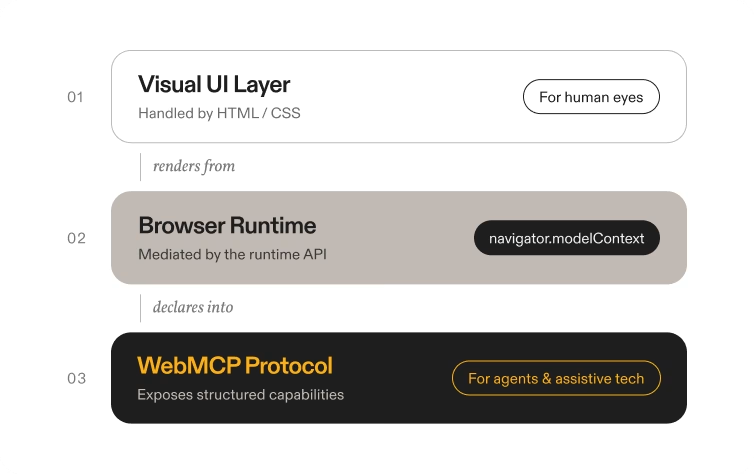
navigator.modelContext shown as the interface. The WebMCP Protocol is the bottom layer and exposes structured capabilities intended for agents and assistive technology. The layers are connected sequentially, with the Visual UI Layer rendering from the Browser Runtime and the Browser Runtime declaring into the WebMCP Protocol.When an agent lands on a WebMCP-enabled page, it dXoes not scrape the visual tree. It queries the browser for the page's model context. The website then exposes a clean, structured schema that describes its available capabilities:
This application can execute three core functions: search inventory, check a delivery status, or add an item to a cart. Here are the exact parameters required to run them.
This represents a profound shift in software engineering. We are no longer asking machines to pretend they are humans with eyes. We are giving them a direct programmatic contract.
Because the protocol operates independently of the visual layer, a design team can completely overhaul a website's typography, layout, and framework without necessarily impacting AI integrations, assuming the underlying semantic structure and capability definitions remain stable. The interface has been successfully decoupled from the application's core utility.
2. The Human Element: Radical Inclusion via Autonomy
When we talk about the technical architecture of WebMCP, it is easy to view it strictly as an efficiency gain for engineers or a performance upgrade for AI software. But the true value of decoupling the user interface is measured by the profound impact it can have on human autonomy.
For a user with severe motor, visual, or cognitive disabilities, navigating the modern web isn't an exercise in seamless browsing. It is an exercise in friction.
Every year, web applications become more visually complex, dynamic, and fragile. A consumer trying to execute a routine transaction, such as managing a utilities dashboard or filling out a donation form, is frequently met with a gauntlet of unlabeled form inputs, hidden keyboard focus traps, and complex modal windows that refuse to announce themselves properly to assistive technologies.
Historically, our approach to this problem has been reactive. We audited code, patched broken elements after shipping, or worse, relied on superficial accessibility overlays that broke the browser runtime entirely. We forced the human user to adapt to an interface that was never built for their functional needs.
WebMCP changes the terms of the equation. By allowing a web application to natively expose its operational capabilities through navigator.modelContext, we give users the option to bypass portions of the visual layout entirely through trusted AI assistants.
Shift in Digital Access Models
Consider what this looks like in practice. A user with an advanced progressive motor condition might find it exhausting to manually tab through an intricate, multi-stage layout just to update their account billing preferences.
On a WebMCP-enabled site, that user could instruct their personalized AI assistant to handle the task. The assistant queries the browser, reads the developer-defined capability schema, and executes the necessary API calls within the secure browser session.
The user is no longer forced to wrestle with an inaccessible interface. Instead, they are empowered to deploy an agent that speaks the application's language natively.
This represents a compelling extension of inclusive design in an increasingly agentic ecosystem. We are not erasing the visual web; we are liberating the underlying utility of our applications so that access is granted not solely by a user's ability to click a specific pixel, but increasingly by their intent.
3. The Third-Party Integration Challenge
This model of radical inclusion only works if it spans the entire ecosystem. The reality of modern web development is that no website is an island. A massive share of core functionality, including payment gateways, calendar bookings, and interactive forms, is built using third-party applications embedded via <iframe> containers.
This creates a critical boundary line for enterprise architecture. Because of the browser's Same-Origin Policy, a host website cannot declare WebMCP capabilities on behalf of an embedded application. Doing so would violate basic web security, allowing one site to read data inside another's secure container.
Instead, WebMCP relies on a federated model of capability. When an AI agent lands on a page, the browser runtime securely aggregates the model contexts frame-by-frame.
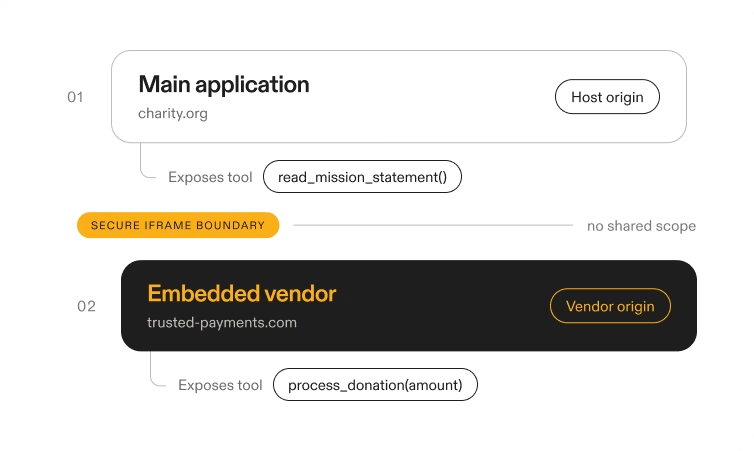
read_mission_statement() tool. The embedded vendor is hosted on trusted-payments.com and has vendor-origin access. It exposes a process_donation(amount) tool. The diagram indicates that there is no shared scope between the two origins.The host application handles its native tools, while the embedded application independently registers its own transactional contracts, like process_donation. The agent interacts with each layer securely, maintaining strict cryptographic boundaries.
For organizations that rely on third-party vendors, this shifts the procurement conversation entirely. To maintain consistency across experiences, engineering teams must look beyond whether a vendor's widget "looks" accessible. They should also inspect whether the iframe explicitly requests the model-context permission within its HTML attribute:
<iframe src="https://trusted-payments.com/donate" allow="model-context"></iframe>If a third-party vendor fails to implement WebMCP, their widget may become a dead zone for autonomous agents at critical moments in the transaction flow. In an ecosystem increasingly driven by automated assistance, the ability for a vendor's tool to clearly declare its capabilities to the browser is becoming an increasingly important capability.
4. The Executive Reality: Why the "Agentic Web" Still Needs Human Remediation
As WebMCP begins to reshape the structural landscape of the internet, it is easy for enterprise leaders to fall prey to a dangerous architectural illusion. The logic seems seductive: if our website natively exposes a clean, machine-readable tool schema directly to the browser runtime, then the messy, expensive work of traditional web accessibility auditing and remediation is officially a thing of the past.
This assumption is not just wrong. It is a profound compliance and operational risk.
WebMCP is not a magical self-repair mechanism for a broken digital property. It is a progressive infrastructure enhancement. Far from making web accessibility obsolete, the rise of the decoupled user interface actually raises the financial stakes of bad engineering.
If your underlying website is poorly constructed, even a strong implementation of WebMCP may struggle to deliver a reliable experience. There are three core reasons why human-led auditing and remediation remain the definitive line of defense.
1. Collaborative Frameworks: Humans and Agents Share the Same Interface
A fundamental characteristic of WebMCP is that it is built for shared user sessions. A user's autonomous agent does not browse a website in a closed sandbox; it operates alongside the human user in real time.
Consider a user navigating a complex corporate client portal using a screen reader or another assistive technology. They do not necessarily hand total control to an agent. Instead, they interact with the page, gather context, and direct the agent based on what they experience:
"Read the terms of service paragraph on the screen."
"Click the confirm button that just appeared."
If the visible webpage lacks a semantic heading hierarchy, sufficient contrast, or contains keyboard focus traps, the human user may struggle to establish the context required to direct their assistant. If the human experience of the interface is broken, the collaborative experience becomes significantly more difficult.
2. The Sandbox Prerequisite: Clean Semantic HTML
WebMCP tools execute within the live client-side DOM. They inherit the structural health of the underlying source code.
If an engineering team registers a brilliant WebMCP function like execute_checkout(cart_id), but the actual checkout page is a chaotic tangle of nested <div> tags devoid of explicit form boundaries, correct input types, or accurate programmatic associations, execution of the transaction payload may become unreliable.
An AI agent navigating via WebMCP still benefits from standard, semantic HTML to understand an application's states and hierarchies. Before a developer can successfully declare a tool contract through navigator.modelContext, the baseline environment should be structurally sound.
If you pass clean agent data into a garbage code environment, the transaction still breaks.
3. The Validation Gap: Auditing the Tool Descriptions
In the world of WebMCP, the natural language descriptions written into your tool schemas are no longer just passive documentation. They are active instructions that an AI interprets.
If an overworked developer builds a tool definition like this:
{
  "name": "update_account_data",
  "description": "Updates stuff on the user profile page."
}
The visiting AI assistant may misunderstand the tool's true boundaries, infer incorrect parameters, pass invalid data types, or fail to invoke the tool entirely.
This shifts the paradigm of digital accessibility audits. The role of a remediation partner is evolving from simply scanning for missing alt text to auditing the semantic and logical integrity of API descriptions. We analyze tool schemas to ensure they are clear, deterministic, and accurately represent an application's underlying business rules.
Conclusion: The New Cost of Non-Compliance
In the legacy web, a broken button or a missing label was a quiet tragedy. It frustrated and excluded a percentage of users, frequently going unnoticed by executive leadership until a formal complaint or lawsuit arrived.
In an agentic ecosystem, the financial penalty for bad code may become more immediate and automated. If an AI assistant encounters a broken DOM element or an ambiguous WebMCP schema description, it may halt execution, abandon the session, and direct the user elsewhere.
We are not entering a future where websites magically fix themselves. We are entering a world where bad code carries a higher cost.
Enterprise longevity in this new era requires a steady, collaborative partner to ensure that your digital foundation is robust enough to withstand the scrutiny of both human users and machine logic.