


What Real Accessibility Work Actually Looks Like
Run a scan.
Install a widget.
Fix a few warnings.
Call it accessible.
That's how a lot of companies still approach accessibility.
Real accessibility work looks totally different.
Accessibility affects design, development, content, user experience, QA, and long-term site governance. It isn't something you install or check off a list. It's something you build into how a website is designed, developed, tested, and maintained.
Automated scans, overlays, widgets, AI tools, and accessibility reports can all have value in the right context. But they generally don't fix the underlying accessibility issues in a website's code, structure, or user experience.
Reports help identify barriers.
They don't remove them.
Fixes do.
What a Real Accessibility Audit Includes
A proper accessibility audit is more than an automated scan.
It combines automated testing with manual review of real user experiences.
Automated Testing Helps Identify
- Missing alt text
- Some color contrast failures
- Basic code and structure issues
- Repetitive errors across pages
Manual Testing Helps Validate
- Keyboard navigation
- Menus and interactive components
- Forms, labels, and error handling
- Checkout and lead-generation flows
- Screen reader usability
- Focus states and tab order
- Mobile interactions and touch targets
- PDFs and embedded documents
Why Both Matter
Automated tools are excellent at finding certain types of issues.
They cannot fully judge usability, clarity, or whether someone can successfully complete key tasks.
For example, a website may receive very few automated warnings while its navigation is difficult to use with a keyboard or a customer can't complete a checkout without a mouse. The code passes basic checks, but the experience still breaks down.
Automated tools inspect code.
People experience websites.
That's why meaningful accessibility work combines automation with human review.
Automated scans, overlays, widgets, AI tools, and accessibility reports can all have value in the right context. But they generally don't fix the underlying accessibility issues in a website's code, structure, or user experience.
What Real Remediation Includes
Finding issues is only step one.
Remediation is where meaningful progress happens.
That may involve:
- Fixing templates used across the site
- Rebuilding inaccessible navigation
- Correcting forms and validation behavior
- Improving page structure and headings
- Updating shared design patterns and components
- Fixing content practices that create repeat issues
- Retesting after changes are made
Good remediation rarely focuses on fixing one page at a time.
Instead, it focuses on fixing the templates, components, and design patterns that create the same issue across hundreds or even thousands of pages.
That's how organizations make lasting progress instead of repeatedly fixing the same problems.
A report alone does not improve accessibility.
Fixes do.
Accessibility Debt Is Real
Most software teams understand technical debt.
Accessibility has its own version.
Every inaccessible template, component, or design pattern gets reused across more pages.
The longer those issues remain, the harder and more expensive they become to fix.
Building accessibility into projects early is usually far more efficient than correcting the same problems later.
Why Doing It Right Matters
Quick fixes often address symptoms instead of root causes.
That creates a cycle of repeated issues, wasted time, and false confidence.
Doing accessibility properly can help teams:
- Remove barriers that prevent customers from completing important tasks
- Improve checkout, contact, and conversion experiences
- Prevent repeat issues from returning
- Build stronger internal processes
- Reduce avoidable compliance risk
- Protect brand trust and reputation
Accessibility isn't separate from business performance.
It directly affects how people experience your company online.
Benefits of Strong Accessibility Work
Better User Experience
Cleaner navigation, clearer forms, and more predictable interactions help many users complete tasks faster and with less frustration.
Better Business Outcomes
Reducing friction can help improve completion rates for purchases, applications, bookings, and lead forms while creating a better experience for customers.
Stronger SEO Performance
Accessible websites often use clearer structure, headings, labels, and semantic HTML. That can support search engine understanding and improve crawlability.
Better AI Discoverability
As AI search and answer engines continue to grow, well-structured, readable websites can be easier for machines to interpret accurately.
Cleaner Code and Easier Maintenance
Fixing accessibility often improves markup quality, component consistency, and overall front-end discipline. That makes future updates easier.
Lower Long-Term Costs
Systemic fixes are usually more efficient than endless patching or repeated one-off repairs.
Stronger Brand Credibility
Inclusive digital experiences build trust and demonstrate organizational maturity.
More Sustainable Operations
When accessibility becomes part of everyday workflows, teams move faster, create fewer repeat issues, and build better digital experiences over time.
Why Mid-Sized Companies Often Need the Most Support
Mid-sized companies are often in the hardest position.
They have real traffic, real customers, and real expectations.
But many do not have:
- In-house accessibility specialists
- Mature QA processes
- Clear ownership internally
- Time to manage remediation alone
That is where expert outside guidance becomes valuable.
Where Ally Fits In
Ally helps companies handle accessibility in a practical, execution-focused way.
Our work typically includes:
- Full accessibility audits
- Prioritized remediation plans
- Hands-on collaboration with internal teams
- Validation testing
- Ongoing monitoring
- Long-term accessibility guidance
We don't stop at identifying issues.
We focus on what gets fixed, what improves, and what lasts.
Our goal isn't simply to deliver a report.
It's to leave your website, your design system, and your internal processes in a stronger position than when we started.
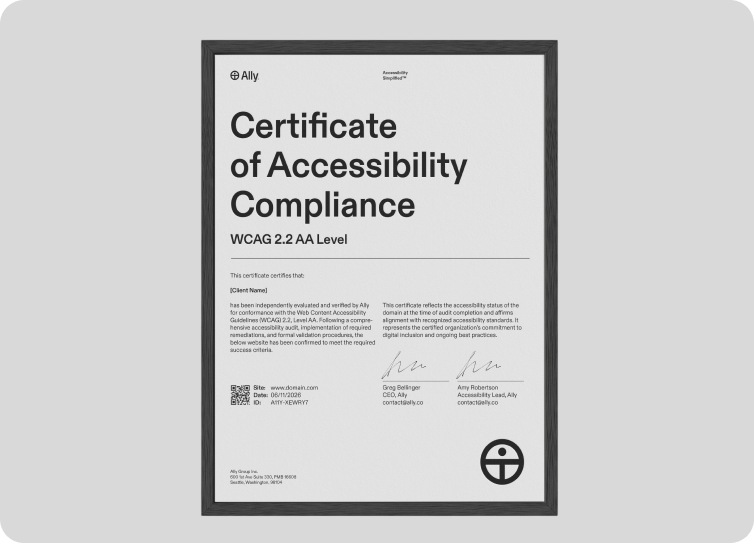
Ally Certification
After remediation and review, we also offer Ally Certification.
It isn't a shortcut badge or an automated score.
It reflects meaningful accessibility work that has gone through Ally's documented review process.
That can help support:
- Leadership confidence
- Procurement conversations
- Internal accountability
- Ongoing governance efforts
Final Thought
I've been building websites since 2008, and one thing still surprises me.
Brand-new websites launch every day with serious accessibility barriers.
This isn't simply the fault of individual organizations. It reflects a broader issue across the web industry, where accessibility has too often been treated as an afterthought instead of a fundamental part of building websites.
Accessibility is often underestimated because many barriers remain invisible until someone depends on the experience.
That's why shortcuts can look appealing.
Thus, lasting accessibility doesn't come from a widget, a scan, or a one-time report.
It comes from real audits, meaningful remediation, continuous testing, and long-term accountability.
Accessibility isn't measured by how many issues a scanner finds.
It's measured by whether real people can successfully use your website.
Done well, accessibility becomes more than a compliance effort. It becomes a better way to build.